Testing
Test categories
Tests fall into these groups:
- Golden tests (
tests/golden/) reproduce monograph tables through the Cole-Cole pipeline. - Property tests (Hypothesis) check tissue and Fresnel invariants (for example T_0 in (0,1), bounded transmission).
- Regression tests compare against the Mie analytical solution. The Mie test is the CI canary.
- Engine tests run
PropagationPathsthroughDosimetryResulton synthetic meshes for incoherent levels 0-6. - Coherent tests cover levels 7-8 (Q matrix, ECBF, precoder).
- Viewer tests hit Flask JSON routes, auth, config, compute helpers, and voxel fixtures. The React UI is under
aegis-web/. Full 3D interaction is left to manual QA or browser automation. - Visualization tests build heatmaps, dashboards, and comparison plots.
@pytest.mark.slow marks tests that need mesh files, itis_v5.db, or similar. It does not label wall time. The filter pytest -m "not slow" still spends most time on coherent kernels, Hypothesis, optional JAX, and Plotly.
Running tests
List what pytest will run:
Typical commands:
pyproject.toml sets pytest-xdist to two workers (-n 2). That splits work across two processes without spawning one worker per CPU. For a single process (debuggers, tight RAM), run pytest -n 0. Avoid pytest -n auto on a workstation unless you know RAM headroom.
Pre-commit runs ruff and codespell only. GitHub Actions runs pytest tests/ with coverage on every push and PR, including slow tests. The Full test suite (manual) workflow is for optional manual runs with verbose output and Git LFS checkout.
Coverage
Some paths are omitted from coverage reports where line counts mislead more than they help. See [tool.coverage.run] omit in pyproject.toml (optional Sionna bridge, viewer CLI entry, pipeline glue).
Engine test structure
test_engine.py uses synthetic meshes so most tests need no external data:
- Flat plane (100 triangles, +z normals): normal incidence, grazing, backside, P_abs = T_0 * A_total.
- Icosahedron (20 triangles, near-spherical): non-negative S_ab, energy bounds, multi-path cases, level checks.
Coherent test structure
See tests/test_coherent.py for the MIMO pipeline, Q, ECBF, and level 7-8 engine behaviour.
Data dependencies
Slow tests may require:
golden/test_tables.py:itis_v5.dbunder the data directorytest_mie.py:miepythonand SciPy (in[dev]extras)test_geometry.py(slow cases):thelonious.stltest_engine.py::TestE2EThelonious:thelonious.stl
Data ships in data/ in the repo. Override with AEGIS_DATA_DIR if needed. For local parity with CI and Docker builds, install Git LFS and run git lfs pull after cloning so any LFS-backed assets in data/ are present before slow tests or image builds.
Golden test values
Table 1 (Fresnel, skin at 28 GHz): T_s, T_p, T_avg at 0, 30, 45, 60, 75 degrees. Tolerance: 0.002.
Table 4 (T_0 vs frequency, IT'IS skin): T_0 at 6, 10, 28, 40, 60, 100 GHz. Tolerance: 0.003.
Table 5 (skin dielectric properties): eps_r and |n| at 6, 28, 60, 100 GHz. Tolerance: 2% relative for eps_r, 0.05 absolute for |n|.
Mie regression (the canary)
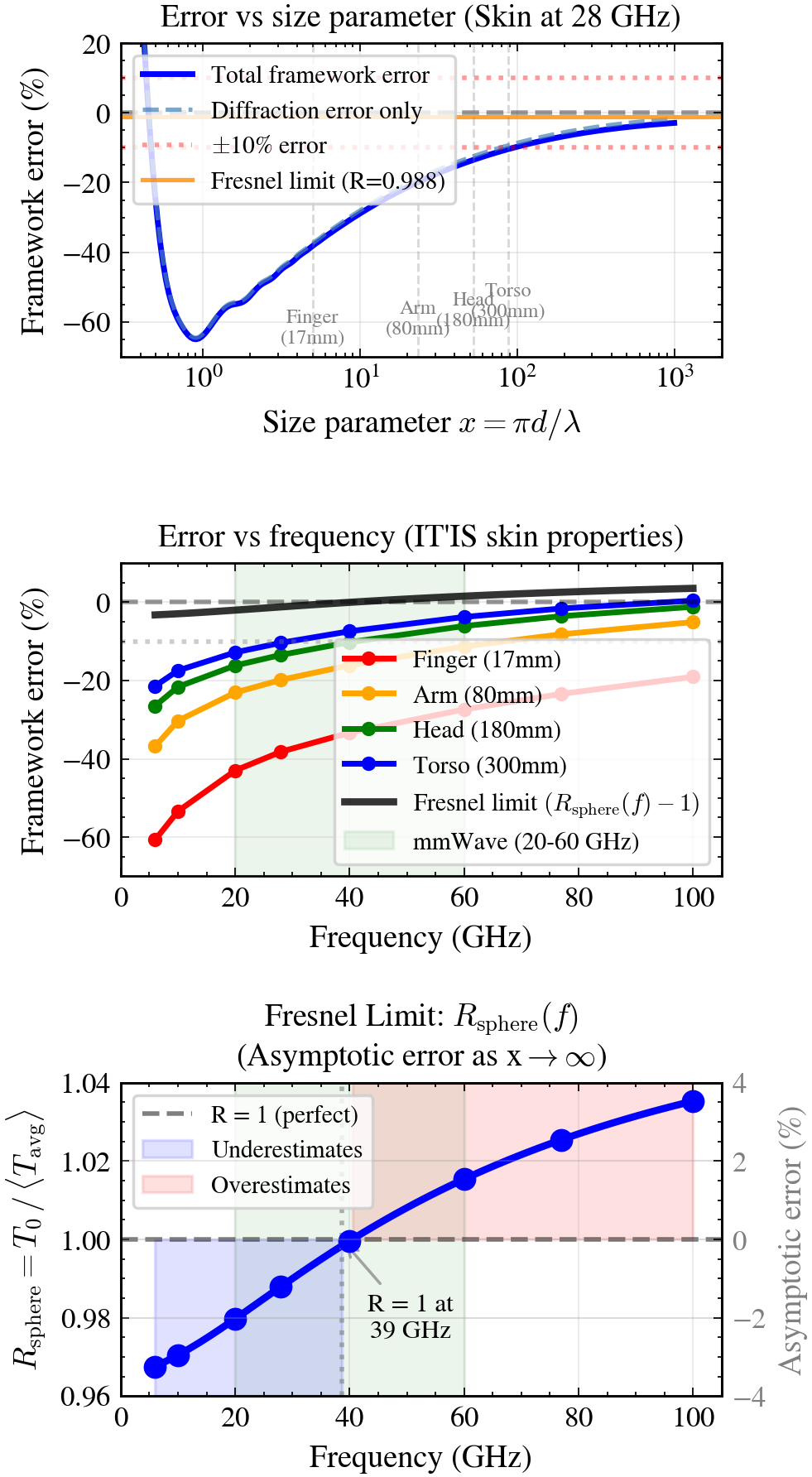
Framework error vs Mie analytical solution. Top: error vs size parameter. Middle: error vs frequency. Bottom: Fresnel limit \(R_{\mathrm{sphere}}(f)\).
The Mie test compares the framework to an independent analytical solution. It computes R_sphere = T_0 / Q_abs_GO for skin at 28 GHz and checks:
- R_sphere ~ 0.988 (framework underestimates by ~1.2%)
- R_sphere < 1.0 (conservative at 28 GHz)
- Error decreases monotonically with sphere size
- Large-sphere Q_abs converges toward the GO limit
If this test fails, the Fresnel or tissue path is wrong in a fundamental way.